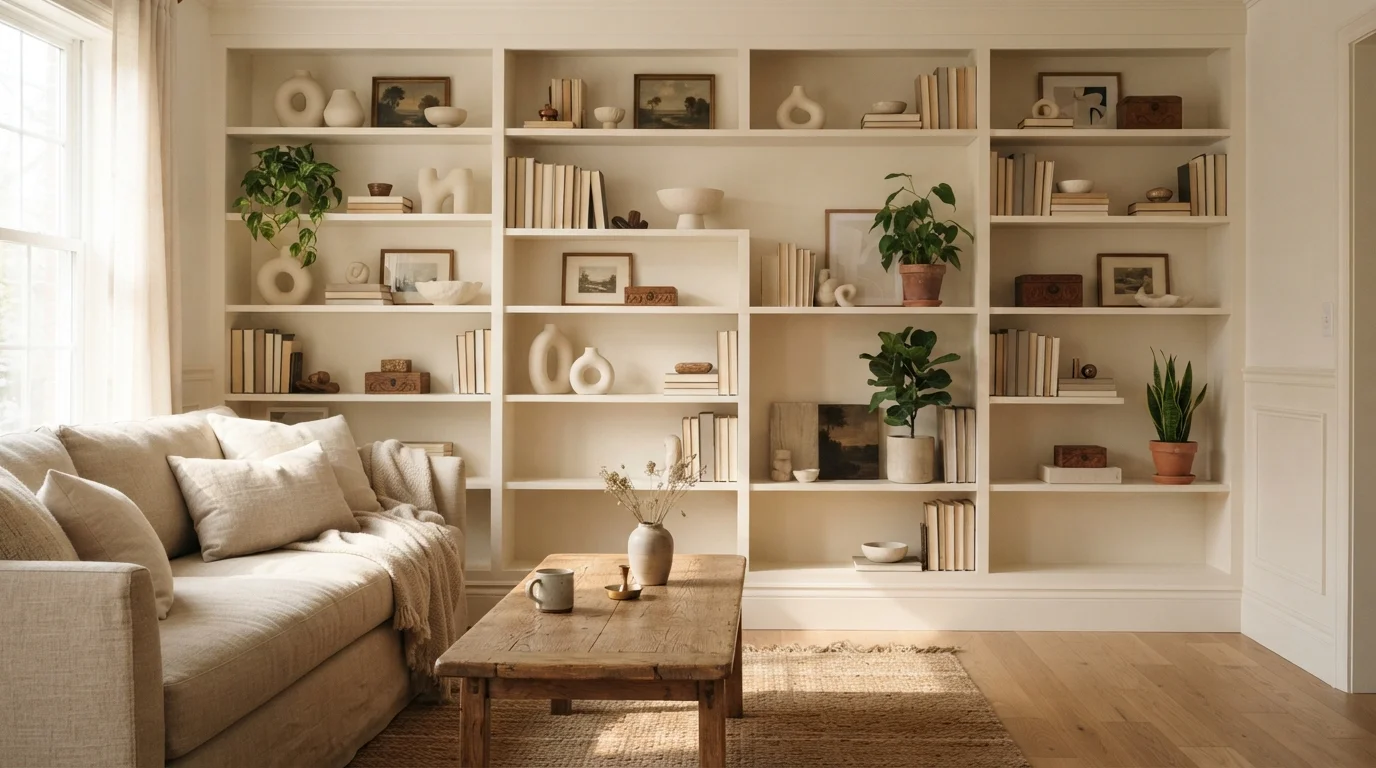
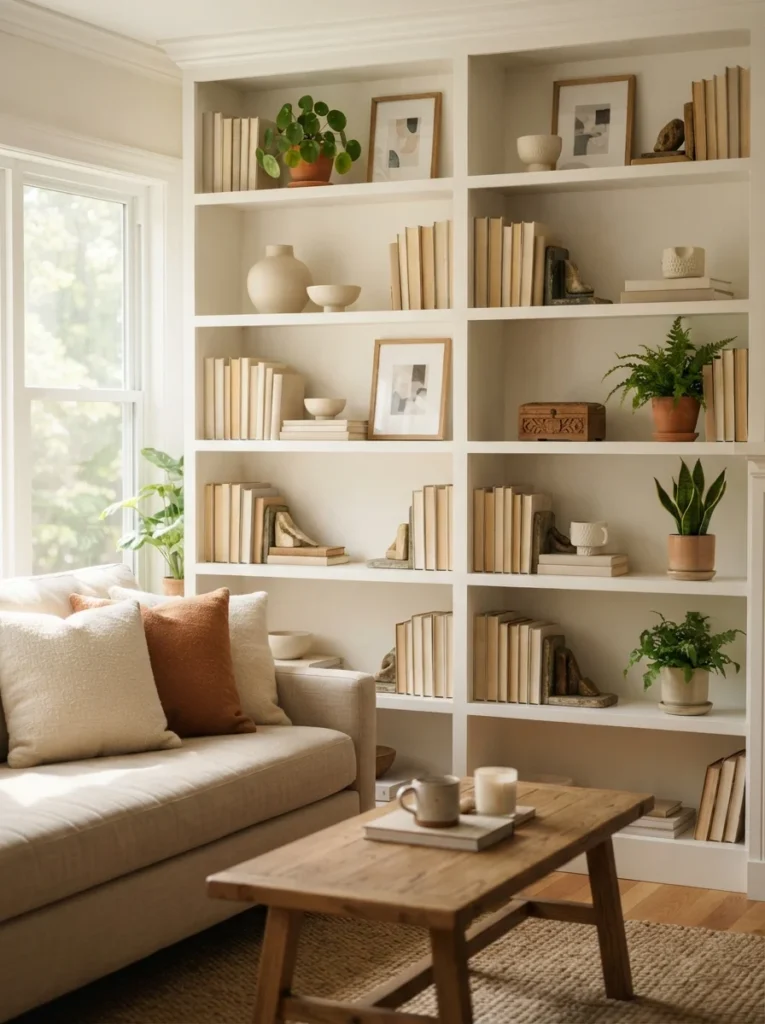
A bookshelf can hold plenty of beautiful things and still look messy. Maybe the books are packed tightly together, every shelf has a different color scheme, or the little accessories seem to compete for attention. The trick isn’t buying more decor. It’s giving the books, artwork, and favorite objects enough space to stand out.
Learning how to style bookshelf decor in a living room takes about two hours and can cost as little as $20 to $60 if you already own books and a few decorative pieces. You’ll finish with a bookshelf that feels collected, personal, and thoughtfully arranged, whether you’re working with a tall IKEA bookcase, built-in shelves, or a small thrifted cabinet.
Time: 2 hours | Cost: around $20–$60 | Difficulty: Easy | Best for: Living rooms, apartments, rental homes, and open-plan spaces
What You’ll Need
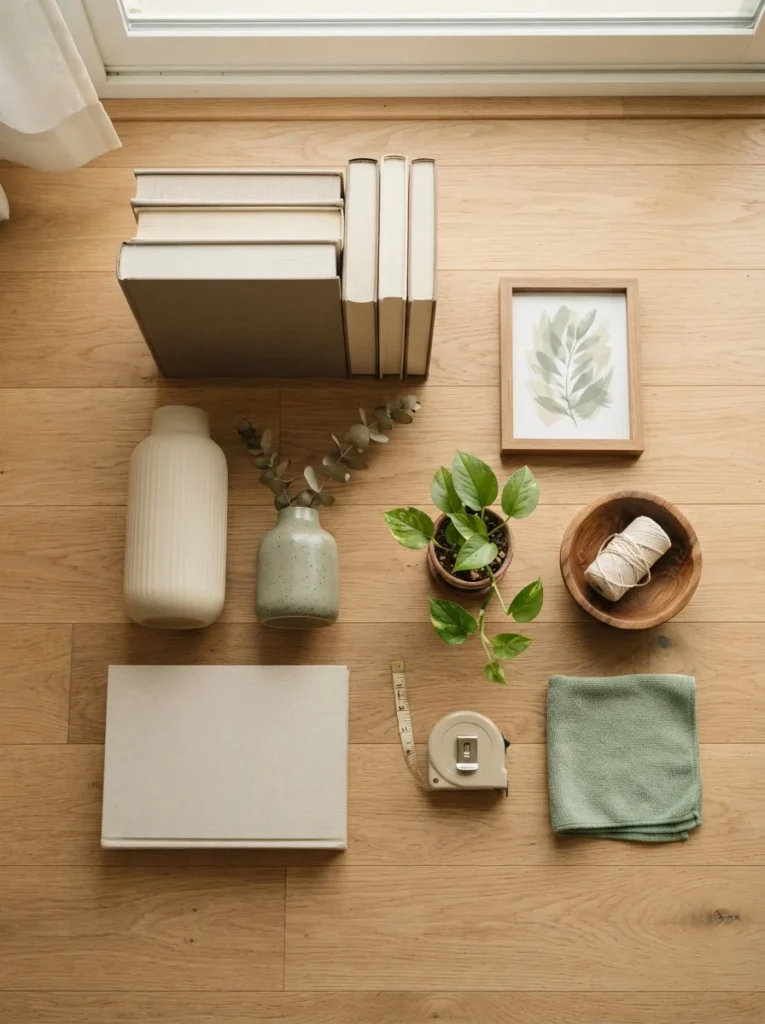
- Microfiber cloth and household cleaner, around $4–$8 if you need to buy them
- Tape measure, around $5–$10
- Hardcover books from home or thrift stores, around $0–$15
- Two ceramic vases, around $10–$20
- Small framed print or family photo, around $5–$12
- Small potted plant or artificial greenery, around $5–$12
- Decorative wooden bowl or sculptural object, around $5–$10
- Woven storage basket, optional, around $8–$15
- Painter’s tape, optional, around $4
You don’t have to purchase every item on this list. Start by gathering your books, framed photographs, souvenirs, and bowls from around the house. A few pieces with different heights and textures are more useful than a dozen matching accessories.
1. Clear the Bookshelf and Measure Each Shelf
Remove every book and accessory from the bookcase, then wipe the shelves with a microfiber cloth. Dust tends to gather behind book spines and along the back corners, so don’t skip those areas. While the shelves are empty, check for loose brackets, peeling veneer, or scratches that need attention.
Measure the width, depth, and vertical clearance of each shelf. Write the measurements on a piece of paper, especially if you’re styling an IKEA BILLY bookcase or another unit with adjustable shelves.
Allow about 15 minutes for cleaning and measuring. The mistake to avoid is assuming every compartment has the same height. A tall vase that fits the top shelf may not fit the shorter space underneath.
2. Pick Three or Four Colors for Your Display
Look at the sofa, rug, curtains, and wall color before choosing shelf accessories. If your living room has a beige sofa and oak furniture, cream, muted green, warm brown, and black make a comfortable palette. For a colorful room, repeat one or two existing shades rather than introducing several unrelated ones.
Gather the objects that fit your palette and place them together on the floor. You can still keep a bright red travel souvenir or a colorful family photograph if it means something to you. Just let a few quieter pieces surround it.
Choose three or four main colors, including the natural colors of wood or book covers. Too many competing colors can make a small bookshelf feel busy, even if the shelves aren’t full.
3. Plan the Layout Before Placing Every Object
Think of the bookshelf as one large display rather than a collection of separate compartments. Assign a few shelves to books, others to artwork and pottery, and one lower section to baskets or practical storage. On a bookcase with six shelves, for example, dedicate three to books, two to decorative arrangements, and one to storage.
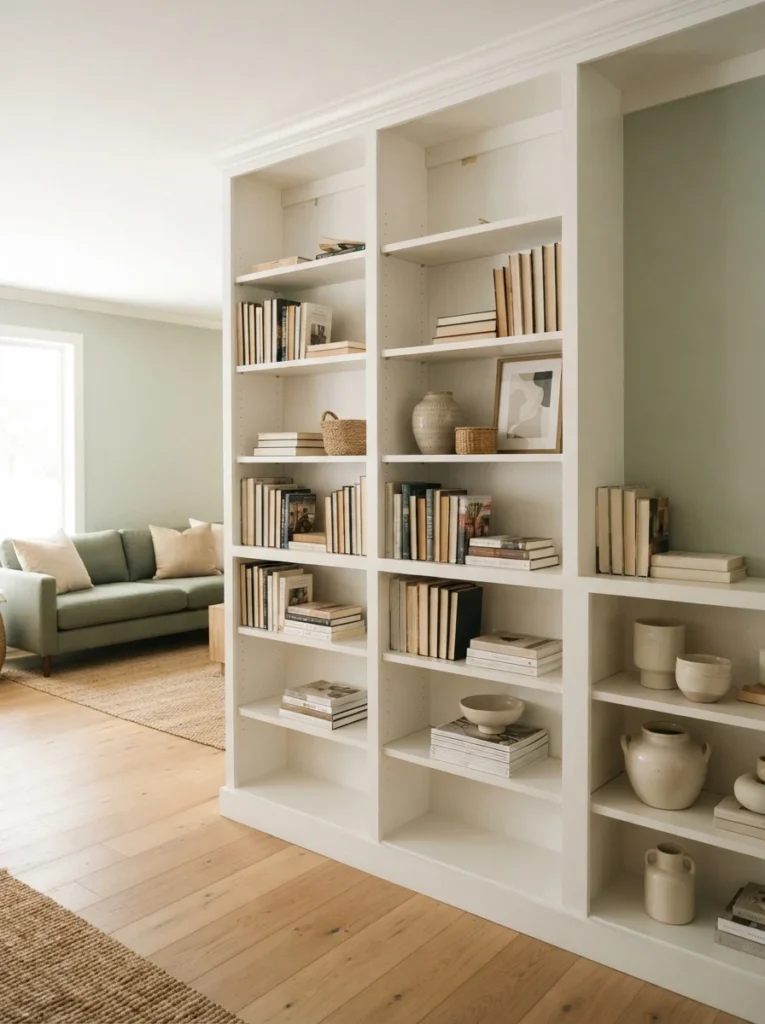
Stand back about six feet and look at the empty spaces between your planned groups. Leave approximately 25–35% of the visible shelf area open as a starting point. This breathing room helps individual objects stand out instead of disappearing into a crowded arrangement.
Avoid filling every shelf simply because you have enough belongings to do it. Some compartments look better with only a small stack of books and one decorative piece.
4. Mix Upright Books With Horizontal Stacks
Books are the backbone of bookshelf decor, so arrange them in a way that adds variety. Stand five to seven books upright on one side of a shelf, then place two or three larger books horizontally on another. A horizontal stack creates a low platform for a small bowl, candleholder, or ceramic object.
Sort books loosely by color or subject, but don’t worry about making every spine match. A few colorful titles add personality to a neutral display. If the shelf is deep, move the books toward the back and leave a little space in front for one small accessory.
Keep roughly 1–2 inches of clearance above the books when possible. A common mistake is pushing every book tightly together, which makes the arrangement feel heavy and leaves no room for decorative objects.
5. Create Small Decorative Groupings With Different Heights
Now bring in your vases, bowls, framed photos, and sculptural objects. Arrange two or three pieces together, using a tall item, a medium-height item, and a shorter piece. For instance, pair a 9-inch ceramic vase with a 5-inch wooden bowl and a short stack of books.
Vary the shapes, too. A rounded vase next to a rectangular frame looks more interesting than three similarly shaped objects lined up in a row. You can find affordable ceramic pieces at Target, Walmart, or local thrift stores without buying an entire matching set.
Keep most groupings to two or three objects. The mistake is adding tiny decorations to every available gap. If you can’t easily identify the main object in a grouping, remove one or two smaller pieces.
6. Add Artwork for a More Collected Look
A bookshelf filled entirely with books can look flat, especially if every spine has a similar height. A small framed print introduces another shape and gives the eye somewhere to pause. Try an 8-by-10-inch botanical print, a family photograph, or a small landscape painting.
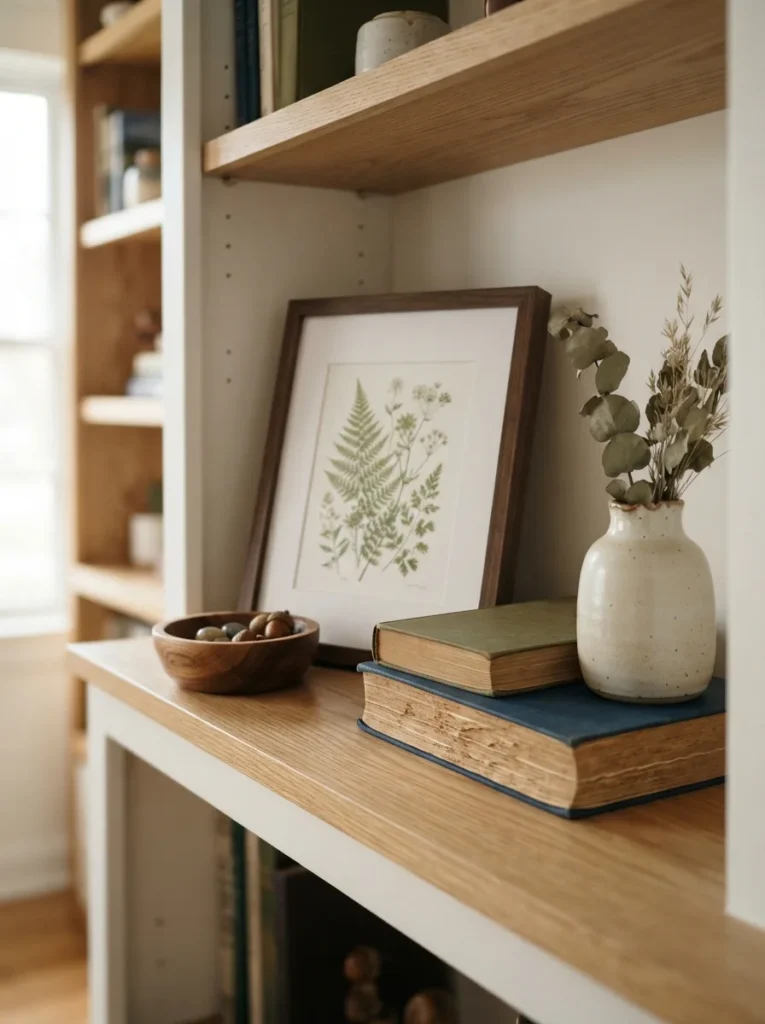
Lean the frame against the back panel if the shelf is deep enough, or use a freestanding frame with a secure stand. Keep heavier frames stable, especially if children or pets can reach the bookcase. For rental homes, leaning art avoids putting extra holes in the wall.
Choose artwork around half to two-thirds of the shelf’s width for a balanced focal point. Avoid covering most of the books behind it. For more ideas, see [INTERNAL LINK: article about living room wall art ideas].
7. Use Plants and Natural Textures to Soften the Display
Bookshelves have plenty of straight lines, so a little greenery and natural texture can make the arrangement feel less rigid. A small pothos, peperomia, or artificial eucalyptus plant works well beside books or near the outer edge of a shelf. Woven baskets, wood bowls, and linen-covered boxes add texture without introducing lots of extra color.
Check the light level before choosing a real plant. A shelf beside a bright window suits many houseplants, while a dark corner is usually easier to decorate with realistic artificial greenery.
Use one or two plants across a standard bookcase instead of placing greenery in every compartment. Keep trailing leaves short enough that they don’t cover nearby books, and avoid placing plants where water can damage wooden shelves.
8. Balance the Shelf From Top to Bottom
A bookshelf can look top-heavy if all the large objects sit on the upper shelves. Spread the visual weight throughout the bookcase. Put a taller vase or framed print on an upper shelf, medium-sized book stacks around the middle, and a substantial basket or large books toward the bottom.
If your shelves flank a fireplace, aim for a similar visual weight on each side without copying every arrangement. A dark framed print on one side can be balanced by a dark bowl or a stack of books on the other.
Place heavier books and storage baskets on lower shelves for easier access and better weight distribution. The mistake is treating the top and bottom shelves as afterthoughts. Look at the entire bookcase from across the room before deciding that the arrangement is finished.
9. Edit the Shelf and Hide Everyday Clutter
Once everything is arranged, step back about six feet and take a photo with your phone. The picture often reveals crowded spots that aren’t obvious when you’re standing close to the shelves. Look for repeated shapes, accessories touching one another, and places where too many small objects compete for attention.
Remove at least one item from any group that feels crowded. Put loose cables, remote controls, spare chargers, and miscellaneous household items into a woven basket on the bottom shelf. Keep objects you use regularly within easy reach.
Spend the final 10 minutes editing instead of shopping for more decor. The biggest mistake is adding extra pieces to fill empty areas. Empty space is part of the design, not a problem to solve.
Mistakes That Ruin the Result
- Filling every compartment: Remove a few accessories and leave open space around the main groupings.
- Using identical objects on every shelf: Vary the heights, shapes, and materials while repeating a few colors.
- Putting all the books together: Distribute books across several shelves and mix vertical rows with horizontal stacks.
- Ignoring everyday storage: Keep remotes, cables, and miscellaneous items in baskets instead of leaving them scattered among decorative pieces.
Frequently Asked Questions
Q: How to style bookshelf decor in a living room for maximum visual impact?
Start with books, then add framed art, pottery, and greenery in small groupings. Repeat three or four colors throughout the shelves and leave around 25–35% of the visible area open.
Q: Should bookshelf decor match the living room furniture?
It should coordinate with the room without matching every piece exactly. Repeat colors from the rug, sofa, or curtains, then introduce a few different materials such as wood, ceramic, and woven fibers.
Q: How many decorative items should go on each bookshelf shelf?
Two or three objects usually work well for a small or medium shelf, especially when paired with books. Larger shelves can hold more, but leave enough open space to separate the groupings.
Q: How do I style a bookshelf on a small budget?
Use books and personal objects you already own, then look for inexpensive vases and frames at thrift stores or Walmart. A budget of $20 to $30 is often enough for a few carefully chosen additions.
Q: How do I decorate a bookshelf without making it look too busy?
Avoid filling every gap with a small accessory. Mix books with a few larger decorative objects, vary their heights, and leave some compartments mostly empty.
Q: Should I arrange books by color or size?
Either approach works, but sorting by size first helps books fit the shelf neatly. You can then group similar colors loosely without making the bookcase look overly coordinated.
Give Your Bookshelf a Weekend Makeover
A well-styled bookshelf doesn’t depend on expensive accessories or a perfect collection of matching books. It comes down to thoughtful spacing, varied heights, a few personal details, and enough open space for each group to stand out. If you’ve been wondering how to style bookshelf decor in a living room, start by clearing one shelf this weekend, shop your own home for accessories, and work through the bookcase one section at a time. Two hours and a few small changes can give your living room a more finished look without a major shopping trip.